Bangkok eSIM
Bangkok moves fast, in heat, traffic, and a swirl of Thai and English signage. A live data connection is what makes it easy: Grab to skip the taxi haggle, maps through the gridlock, and menus translated at a street stall. Here is how to stay online in Bangkok, and dodge the local-SIM paperwork entirely.

An eSIM works, and it is the easier choice. A Thailand eSIM installed before you fly is online the moment you land at Suvarnabhumi or Don Mueang, with fast 4G and 5G across the city. A local prepaid SIM means queueing at a counter and registering your passport, which a travel eSIM skips entirely. For a week of Grab, maps, and translation, around 6 to 10 GB is comfortable.
Staying online in the City of Angels
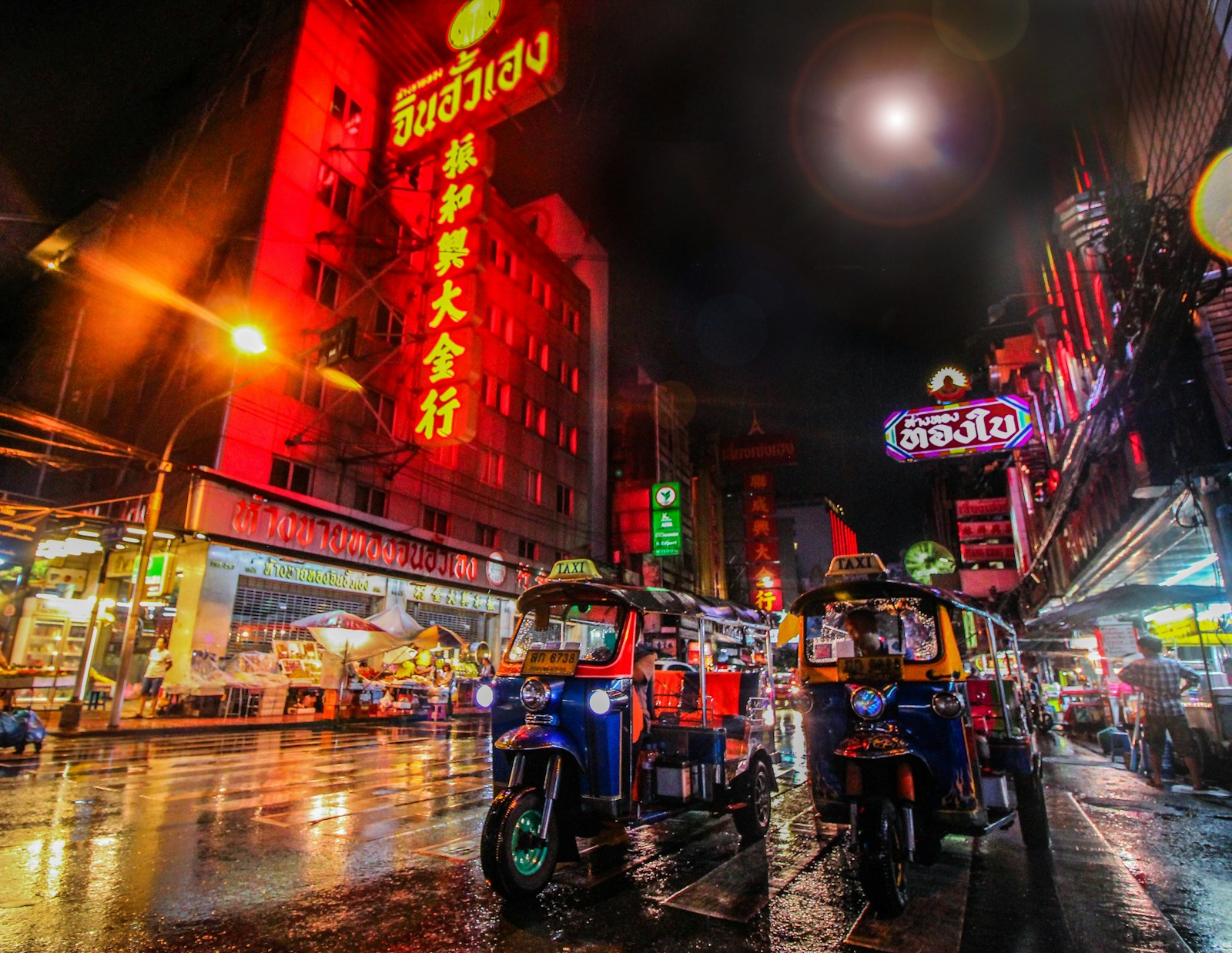
Bangkok rewards the connected traveller more than almost anywhere. The heat and the traffic make walking-and-hoping a poor plan, the BTS Skytrain and MRT metro are quick but need a map to string together, and the best food is often down a soi with no English sign at all. Being online turns the chaos into a city you can actually read, from booking a Grab out of the rain to translating a som tam order at a night market.

How to get connected in Bangkok
Coverage in Bangkok is strong. You get fast 4G and widespread 5G across the city, along the BTS and MRT lines, and at both airports, on the three big networks: AIS, TrueMove H, and dtac. A travel eSIM roams onto them automatically. Signal can dip inside the oldest concrete malls and on a packed river ferry, but for maps and messaging it holds up well across the city.
Choose a Thailand eSIM and pay in crypto, with no card and no ID.
Scan the QR from your dashboard while you are still at home.
It activates at Suvarnabhumi or Don Mueang, so Grab is ready at arrivals.
eSIM vs local SIM vs pocket wifi in Bangkok
Four ways to get online in Bangkok, and the catch with each.
| Option | Ready on arrival | Paperwork | Cost | Best for |
|---|---|---|---|---|
| Travel eSIM | Yes, instantly | None | Low | Almost everyone |
| Local prepaid SIM | After the counter | Passport registration required | Low | Very long stays |
| Pocket wifi | After pickup | Rental and deposit | Medium | Groups sharing one device |
| Home roaming | Yes | None, but watch the bill | Often very high | A quick trip on a cheap plan |
Thailand requires prepaid SIMs to be registered to a passport, so a local SIM means a counter and ID. A travel eSIM avoids that step, which is its quiet advantage here. Costs are rough guides, not quotes.
Getting in from the airport
Most flights land at Suvarnabhumi (BKK); budget and regional flights often use Don Mueang (DMK). From Suvarnabhumi the Airport Rail Link runs into the city in about 30 minutes; from either airport a metered taxi or a Grab is simplest with luggage. Because your eSIM is live at the gate, you can order the Grab before you reach the taxi rank and skip the fare haggling.
Apps that make Bangkok easy
Ride-hailing and food delivery, with the fare fixed up front.
Thailand's default messenger for hotels, tours, and friends.
Routes the BTS, MRT, ferries, and buses door to door.
Neighbourhoods to know in Bangkok
Four very different bases, depending on the trip you want.
Sukhumvit
The modern spine of the city: BTS-connected, packed with hotels, rooftop bars, malls, and easy dining. The safe first-timer default.
Silom & Sathorn
Business by day, night markets and nightlife after dark, and a quick hop to the river. Well linked by BTS and MRT.
Riverside & Old City
Around the Grand Palace, Wat Pho, and Wat Arun. Temples and history, calmer, and best reached by the Chao Phraya ferries.
Khao San & Banglamphu
The backpacker heart: cheap, loud, and central for the old town, though further from the train lines.

Easy day trips from Bangkok
A Thailand eSIM works country-wide, so it keeps going the moment you leave Bangkok, whether you are on a minibus, a train, or a longtail boat. Three favourites within a day of the city:
The old capital's temple ruins, about 90 minutes north by train.
Damnoen Saduak or Amphawa, a classic half-day by road.
Pattaya or Ko Samet for a quick coast fix from the city.
Do you still need a local SIM in Thailand?
For most travellers, no. Thailand's rules require every prepaid SIM to be registered against a passport, so buying local means finding an official counter, handing over your document, and waiting. Airport SIM stalls do this for you, but it is still a queue and a form on arrival.
A travel eSIM sidesteps all of it: it is already yours, already registered to your account, and already working when you land. Unless you are staying for months and want a Thai number, an eSIM is the simpler and more private way to stay connected here.
Practical tips for Bangkok
Beat the heat
Plan indoor stops at midday and carry water. It is hot and humid year round.
Skip the gem scam
Ignore any tuk-tuk driver steering you to a jewellery or tailor shop.
Dress for temples
Cover shoulders and knees for the Grand Palace and Wat Pho.
Carry cash
Street food and small shops are cash-first, though malls take cards.
Why travellers choose SimVala
4.8from 39,452 verified reviews“I only needed data for my holiday, so this was much easier than buying a local SIM.”
“Got a virtual number for some work calls. Setup was easy and calls have been fine so far.”
“Used the eSIM in Greece last week. No setup problems, which was honestly what I wanted.”
“Bought it before flying to Turkey. Had data as soon as I landed. Very convenient.”
“First time using an eSIM. I was expecting it to be complicated, but it took maybe five minutes.”
“Needed a second number for work. So far it has been doing exactly what I needed.”
“Used the eSIM around Italy and Austria. Connection was good everywhere I went.”
“I travel for work quite often and wanted something I could activate before leaving. This worked well.”
“Bought the eSIM the night before my flight. Installed it at home and forgot about it until I landed.”
Bangkok eSIM & travel FAQ
Does an eSIM work in Bangkok?+
Yes. A Thailand eSIM roams onto the local networks (AIS, TrueMove H, dtac) and gives you fast 4G and 5G across Bangkok, the BTS and MRT, and both airports. Install it before you fly and it activates when you land.
Do I have to register a SIM to use data in Thailand?+
Not with a travel eSIM. Local prepaid SIMs must be registered to your passport at a counter, but an eSIM is already tied to your account, so there is nothing to register on arrival.
eSIM or a local SIM for Bangkok?+
For most visitors an eSIM is easier: online the moment you land, no counter, and no passport registration. A local SIM mainly makes sense for very long stays or if you need a Thai phone number.
Is there coverage on the BTS Skytrain and MRT?+
Yes. Signal reaches along the BTS and MRT lines, including underground metro stations, so maps and messages keep working as you cross the city.
How much data do I need in Bangkok?+
For a week of Grab, maps, translation, and messaging, 6 to 10 GB is comfortable. Heavy video or hotspotting runs higher, and you can top up any time.
Can I use Grab as soon as I land in Bangkok?+
Yes. Because your eSIM activates at Suvarnabhumi or Don Mueang, you can book a Grab from the arrivals hall and skip the taxi-fare haggle.
Will my eSIM work in Phuket, Chiang Mai, or the islands?+
Yes. A Thailand eSIM covers the whole country, so the same line works in Phuket, Chiang Mai, and on day trips to Ayutthaya or the coast.
When is the best time to visit Bangkok?+
The cool, dry season from November to February is the most comfortable. March to May is very hot, and the monsoon brings heavy afternoon rain from roughly June to October.
Is Bangkok safe for travellers?+
Bangkok is generally safe for visitors. The main things to watch are common tourist scams, such as tuk-tuk drivers pushing gem or tailor shops, rather than serious crime.
Ready for Bangkok?
Install a Thailand eSIM before you fly and land already online, paid in crypto with no ID.